Tuesday, September 9th, 1823
– [Douglas
continues his journey towards “Upper Canada”, as it was then known; upstate New
York as it is now] At 8 o'clock this morning [9th] I left Utica by
canal-boat for Rochester; sixty miles from here [on the Erie Canal]
without a lock. The fields on its banks are rich and fertile and in general
well cultivated.
The boats are fitted up on good
principles; accommodation for twenty four ladies in one cabin and as many in
the men's. I slept on board but was much disturbed passing the locks [Eh? He's just recorded it
being 60 miles to Rochester without a lock? Interestingly, the Editor of the published copy f his Journal - 1914 - also picks up on this inconsistency] I arrived at Rochester
at 6 o'clock on the 11th [ie, the following day, after a 46 hour journey including two
overnights on board. At just over 1 mile an hour this is considerably slower
than the coach but presumably rather more comfortable].
The Erie Canal website gives a detailed description of boat travel on the canal, as follows:
"...both passenger boats (called "packets" or "packet boats"), usually
horse-drawn, and working boats (also called "line boats" or
"freighters"), drawn by either horses or mules, were common. Originally
intended as a more comfortable alternative to the bone-jarring
stagecoach, the packet boat fell out of favor as railroad travel
improved, and basically disappeared by the latter half of the 1800s.

The image below features a typical packet boat.

Because it was usually hot and stuffy in the cabin in the summer time, passengers commonly sat on deck, what little there was of it, or often on the roof. Because headroom under bridges was usually low, passengers on the roof had to duck their heads, or occasionally, to flatten themselves to the roof to avoid being swept off the roof into the canal. The second image below illustrates a packet boat passing under a bridge, with passengers heeding the call of "Bridge!" or "Low Bridge!" Because travel on the Erie Canal was a leisurely affair -- the usual speed being four miles per hour -- passengers would sometimes disembark where they could, walk along the canal path for a while and re-board at some other convenient spot, sometimes by jumping onto the roof from a bridge."

In 1836 Thomas S. Woodcock made the trip from Schenectady, New York to Buffalo and recorded his experience aboard a packet boat:
"These boats are about 70 feet long, and with the exception of the Kitchen and bar, is occupied as a Cabin. The forward part being the ladies' Cabin, is separated by a curtain, but at meal times this obstruction is removed, and the table is set the whole length of the boat. The table is supplied with every thing that is necessary and of the best quality with many of the luxuries of life.On finding we had so many passengers, I was at a loss to know how we should be accommodated with berths, as I saw no convenience for anything of the kind, but the Yankees, ever awake to contrivances, have managed to stow more in so small a space than I thought them capable of doing.
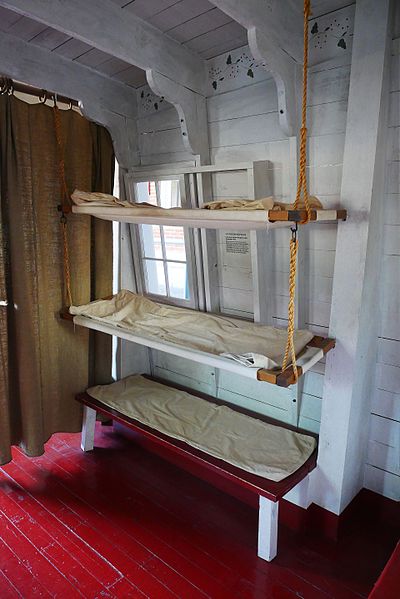
The way they proceed is as follows - the Settees that go the whole length of the Boat on each side unfold and form a cot bed. The space between this bed and the ceiling is so divided as to make room for two more. The upper berths are merely frames with sacking bottoms, one side of which has two projecting pins, which fit into sockets in the side of the boat. The other side has two cords attached one to each corner. These are suspended from hooks in the ceiling. The bedding is then placed upon them, the space between the berths being barely sufficient for a man to crawl in, and presenting the appearance of so many shelves. Much apprehension is always entertained by passengers when first seeing them, lest the cords should break. Such fears are however groundless.
NB - the image below shows what Douglas's sleeping arrangements would have been like.
copyright Sgerbic, via Wikimedia Commons
The berths are allotted according to the way bill, the first on the list having his first choice, and in changing boats the old passengers have the preference. The first Night I tried an upper berth, but the air was so foul that I found myself sick when I awoke. Afterwards I chose an under berth and found no ill effects from the air.
These Boats have three Horses, go at a quicker rate, and have the preference in going through the locks, carry no freight, are built extremely light, and have quite Genteel Men for their Captains, and use silver plate. The distance between Schenectady and Utica is 80 Miles, the passage is $3.50, which includes board. There are other Boats called Line Boats that carry at a cheaper rate, being found for 2/3 of the price mentioned. They are larger Boats, carry freight, have only two horses, and consequently do not go as quickly and moreover have not so select a company. Some boats go as low as 1 cent per mile."
>> From: New York to Niagara, 1836: The Journal of Thomas S. Woodcock, at: "Traveling the Erie Canal, 1836", EyeWitness to History (2004).
Given the speed Douglas records it sounds as though he may have been on one of the cheaper boats!
EDIT - New York State is celebrating the bicentennial of the Erie Canal’s creation this year (2018) with a campaign to “Reimagine the Canal.”

A series of conversations focused on economic and environmental sustainability of the historical Mohawk river towns will be held in Schenectady County beginning March 8th.
These events will kick-off with a presentation by some of the region’s leading experts on the Erie Canal, followed by dialogue on how re-imagining the canal and river can help community revitalization and sustainability in the region.
More info at: http://newyorkhistoryblog.org/2018/02/27/schenectady-county-erie-canal-history-events-set/


