Showing posts with label Dick. Show all posts

Monday, 14 January 2019

Packing up

12th [November, 1823] – Received a letter dated 5th October from Joseph Sabine Esq., [Secretary of the Horticultural Society] accompanied by additional lists; without delay wrote to Messrs Landreth and Smith; called on Mr Floy; Mr Hogg then went to Flushing [site of Mr Prince’s nursery] and returned in the evening. I must observe that Mr Prince Jun., did not receive us with kindness but the reverse. If I can but obtain all the plants for the Society, I shall leave him for some other person.

Thursday, November 13th, 1823 – Wrote to Mr Dick at Philadelphia a letter of thanks. Packed Mr Floy’s box and took up plants and packed Mr Wilson’s.
~~~~~~~~~~~~~~~~~~~
Douglas is now really in the groove of packing all his material up for the voyage back to Britain. But he really does not hit it off with Mr Prince; there'll be another bust up before he leaves New York!

Sunday, 25 November 2018

Mr Coxe is still ill, and a slow journey north

Tuesday, November 4th & 5th, 1823 – In the morning went to Mr Dick’s [Janitor of the University] and got up and packed and sent to the wharf. Mr Dick has several species of Cactus from the Rocky Mountains but they are too small to bear a voyage across the Atlantic.

Left Philadelphia at 12 o’clock and reached Burlington at 4 in the afternoon [of the 4th Nov]. Went to William Coxe, Esq., whom I found still very ill – but considerably better since I saw him before…..[and yet, Douglas goes on to say..] he was not able to leave his room, indeed he was so ill before I left that to appearance he could not live long. [So I guess he must have deteriorated sharply while Douglas was there?] 

I obtained all that was in the house [of varieties of apple seeds], consisting of about eight or nine varieties and only two or three of each, with two bottles of cider seven years old – one made from Wine-sop, one from Virginian crab-apple: this is a present from Thos A. Knight and Jos Sabine Esqs., from Will. Coxe. I also got a few seeds of ornamental plants. I received from him and family all the attention they could give under the present circumstances. 

I had not time to call on Mr Smith, and as I saw all the trees sent off before going to Philadelphia, left Burlington at 2 o’clock in the afternoon [of the 5th Nov] by steamboat for Bordentown, and then by stage to South Amboy. The night was exceedingly dark and rainy; the coach broke down at 11 o’clock at night, and having to stop two hours in repairing, got to South Amboy at 4 o’clock on Wednesday morning. This is a specimen of great speed – twenty-nine miles in thirteen hours.

~~~~~~~~~~~~~~~~~~~~~~~~
 
One can only assume Douglas is being sarcastic about the speed of travel as, at an average of only 2.2mph, he could literally have walked it faster!

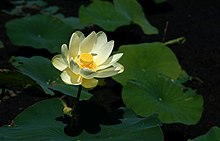
American Lotus - tasty if you can get it


Sunday, November 2nd, 1823 – Today I went in quest of Nelumbium luteum, which grows near Philadelphia, and which I saw in flower when here in August. I made an exertion to procure roots, but I am very sorry to say could not effect this as the roots run to an immense depth. However I am so far pleased at having ten or eleven seeds of it which I trust will grow.

Mr Bartram tried repeatedly to transplant it, without success. Hamilton, of Woodlands, whose domains lie on the banks of the Schuylkill, some years before his death took roots from the field south of Philadelphia and planted them in the mud of the Schuylkill when the tide ebbed and flowed – they grew and flowered well; this is the only instance which has been successfully tried.

Mr Nuttall says on the Mississippi at St Louis it grows much stronger and produces knobs or tubers at the root, which are greedily sought after by the natives. They are washed, boiled and then beat up with butter or grease. He also informs me that when in that quarter he frequently had a dish if them and thought them good. I tried for the tubers here but the immense depth which they run in mud rendered it impossible.

In the afternoon I called on Mr Dick and from his seed cabinet had a portion of everything which I conceived might be useful or interesting to the Society. This gentleman would make a very useful corresponding member. He has the friendship of all American travellers.
Nelumbium luteum is now known as Nelumbo lutea, and it's edible properties remain!
This plant has a large tuber that is used as a food source. This may be the plant called "macoupin" in Miami-Illinois. The seed is also edible and is known as "alligator corn".  It is widely planted in ponds for its foliage and flowers. American Lotus spreads via creeping rhizomes and seeds. 
Nelumbo lutea.jpg
 Wikimedia Commons - Epibase


Philadelphia - meeting Mr Dick and Mr Nuttall


Philadelphia, Saturday, November 1st, 1823 – I waited on Mr William Dick, Janitor of the University of Pennsylvania, from whom I had already received sufficient testimony of his ability and will to make himself useful to me. William Dick was yet another of the Scottish diaspora, busy making gardens wherever they went, so it's not surprising that he & Douglas seemed to get on well.  Dick hailed from Renfrew, Scotland before moving to Philadelphia in 1813 with four of their eventual six children.  William Dick started a family tradition by working as a janitor for the Medical Department from 1813-1831, followed in due course by two of his sons.

Matted watercolor portrait of William Dick
Delivered by the Penn Libraries
© University of Pennsylvania | uarc@pobox.upenn.edu

I had the pleasure here of meeting Mr Nuttall, whom I found very communicative. We looked round Mr Dick’s garden. [Forgive me, but this sounds to me as though it has been lifted straight out of “David Copperfield”!!]

At midday, with Mr Dick, I set out for Messrs Landreths, west of Philadelphia, to whom I am also much indebted for very polite attention. (There is a great similarity of character between Messrs Loddiges [in Hackney, London] and Landreth.)


Landreth’s seed business, visited by Douglas in 1823, was already well-established in Philadelphia, having relocated there from Canada in 1784. Landreth’s is still in business today, familiar I guess to any US readers of this page, and is the fifth oldest corporation in America. 


Douglas’s mention of Loddiges Nursery is also interesting. Their business was very well known and highly prestigious in London at the time Douglas was there. I’ve often wondered whether he visited and this comment of his implies that he did and was familiar with their stock. 

The nursery rose to great prominence during the early nineteenth century under George Loddiges (1786–1846) and it's likely that if Douglas had visited he would have met George
 George Loddiges
Wikimedia Commons

Douglas made another important connection that day. Thomas Nuttall was another famous botanist, plant collector and mineralogist. He was born in Yorkshire; I feel something of a connection with him and have a slow-burning biography project in hand on him.

 
Thomas Nuttall
 
Harvard University Portrait Collection, Gift of Professor Edward Tuckerman to Asa Gray for the University, 1865. Image © President and Fellows of Harvard College